Creating life-like marine video footage used to take expensive camera rigs, deep-sea diving gear, and months of waiting in open waters. Now, Google Veo allows creators to generate broadcast-quality ocean footage directly from text descriptions. Whether you are building a full-length film or short social clips, using the right google veo text to video prompts ocean documentary creators rely on is the secret to photorealistic results.
In this guide, AI strategy expert Deepak shares 12 carefully crafted google veo prompts for underwater wildlife documentary creation. These prompts focus on lighting physics, water clarity, camera movement, and animal behavior to help you produce professional deep sea footage instantly.
Great White Shark Surface Breach
Captures high-contrast surface sunlight and realistic predator movement in shallow water. Expert Insight: Mentioning specific camera lenses like '24mm anamorphic' prompts Veo to generate natural cinematic distortion and realistic field depth.
A cinematic underwater documentary shot of a massive Great White Shark swimming up from the deep blue abyss toward the surface light, photorealistic 8k video quality, 4k resolution, 60fps. Sunlight beams filtering through crystal-clear turquoise ocean water, creating shimmering caustic patterns across the shark's gray back and rough skin texture. Slow camera tracking pan following the shark at eye-level. Tiny air bubbles streaming from its gills. Shot on RED V-Raptor underwater housing, 24mm anamorphic lens, realistic fluid motion, marine documentary style, BBC Blue Planet style.
Bioluminescent Deep Sea Jellyfish
Focuses on pitch-black abyssal environments illuminated solely by organic bioluminescence. Expert Insight: Including 'marine snow particles' creates depth layers in dark water prompts, preventing the background from looking like flat black void.
Ultra-photorealistic 8k footage for a deep sea ocean documentary showing a fragile translucent jellyfish drifting in the pitch-black bathypelagic zone. Pulsating vibrant neon blue and violet bioluminescent light signals ripple down its delicate cilia tentacles. Extreme macro close-up shot, shallow depth of field, subtle floating marine snow particles drifting through dark water. Smooth slow-motion camera orbit around the organism. Natural underwater physics, hyper-detailed texture, National Geographic documentary style.
Green Sea Turtle on Vibrant Coral Reef
Ideal for vibrant tropical reefs with rich daylight color saturation and natural sea turtle motion. Expert Insight: Adding specific companion marine species populates the scene background naturally.
Wide-angle underwater documentary scene of a graceful Green Sea Turtle gliding over a colorful coral reef teeming with tiny clownfish and blue tangs. Bright tropical sunbeams penetrating clear shallow Pacific ocean water. Soft camera dollying alongside the sea turtle as it gently flaps its flippers. Ultra-realistic skin scales, barnacles on shell, water clarity, volumetric light rays, natural color grading, high dynamic range, shot on 35mm underwater lens, smooth movement, pristine photorealistic detail.
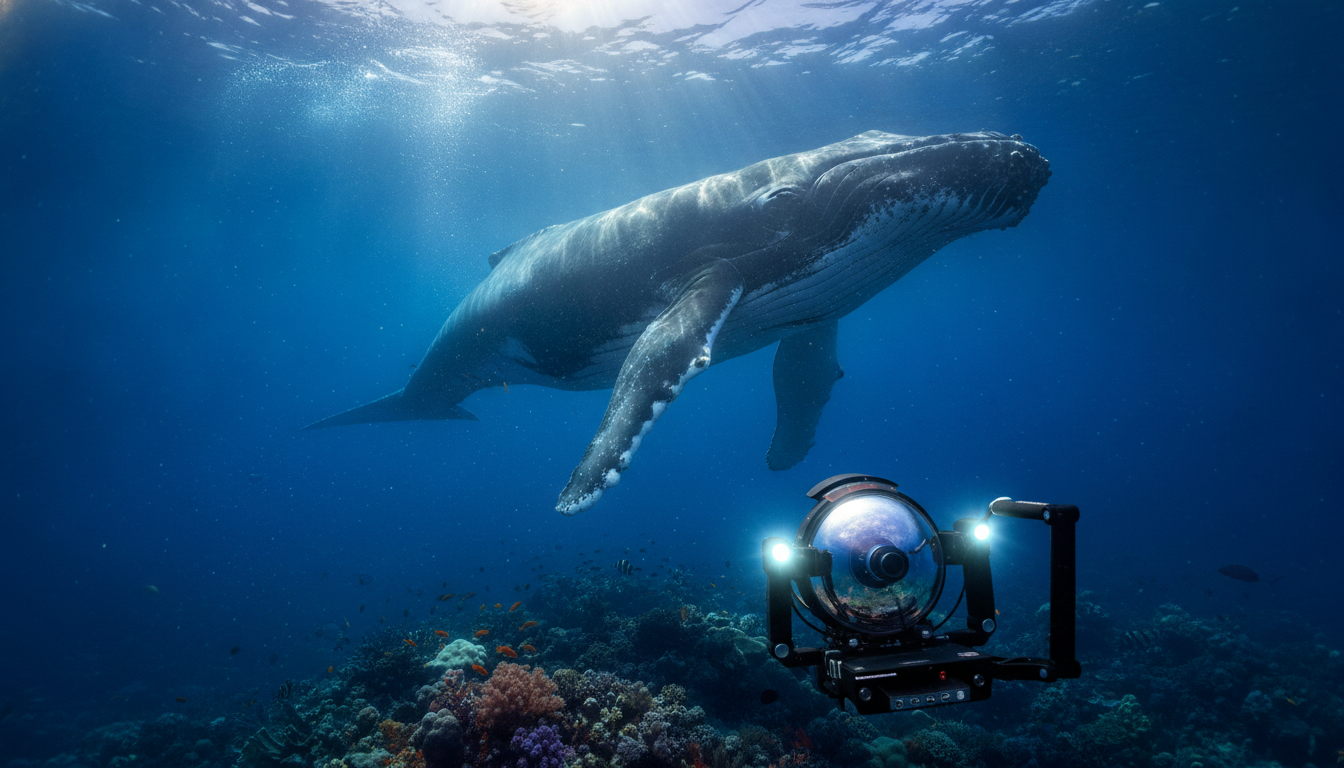
Humpback Whale Mother and Calf
Designed for emotional scale and smooth horizontal movement between large marine mammals. Expert Insight: Setting the camera to track at the 'same speed as the subject' keeps large animals steady within the frame.
Epic cinematic underwater video of a majestic Humpback Whale mother gently swimming alongside her newborn calf in deep open blue ocean water. Sun flare breaking through the upper ocean surface above. Slow wide tracking camera shot moving horizontally at the same speed as the whales. High detail on whale barnacles, throat grooves, and skin texture. Soft underwater acoustics, realistic hydrodynamics, natural deep blue gradient depth, photorealistic marine biology film style.
Giant Pacific Octopus Camouflage Transition
Demonstrates dynamic texture-shifting physics and high skin detail in cold coastal water. Expert Insight: Prompts that describe physical transformations test and showcase Veo's temporal consistency across frame renders.
Detailed close-up text to video prompt of a Giant Pacific Octopus blending perfectly into a rocky granite seabed off the coast of Alaska. Slow zoom-in camera angle as the octopus dynamically shifts its skin texture and color from rough gray stone to vibrant crimson red, expanding its tentacles. Clear cold water, realistic sway of kelp in background currents, micro-details on suction cups, natural documentary lighting, 8k resolution, cinematic focus pull.
Oceanic Manta Rays Night Feeding
Combines high-contrast night settings with artificial directional light sources. Expert Insight: Explicitly calling out directional sources like 'diver floodlights' helps Veo render volumetric lighting through particles correctly.
Spectacular night-dive documentary video of two giant Manta Rays performing graceful barrel rolls through illuminated blue water. Diver underwater floodlights casting strong volumetric light rays through dense clouds of plankton. Cinematic medium wide shot, smooth 60fps frame rate, slow motion, hyper-detailed mouth filter plates and leathery skin. Dark ocean background contrast with glowing plankton, highly realistic fluid dynamics, broadcast quality.
School of Scalloped Hammerhead Sharks
Perfect for massive scale shots, silhouettes, and looking upwards toward the light source. Expert Insight: Upward angles leverage natural surface illumination to highlight silhouetted animal shapes clearly.
Low-angle cinematic documentary shot looking up from the ocean floor toward a massive school of hundreds of Hammerhead Sharks silhouetted swimming overhead. Golden hour sunlight rays cutting down through hazy blue water column. Steady camera tilt upwards, hyper-realistic water density, realistic silhouette outlines with subtle silver metallic skin reflections. Ocean depth perspective, broad scale, BBC Planet Earth style presentation.
Orca Pod Navigating Arctic Sea Ice
Captures emerald cold-water color palettes, floating ice structures, and high-contrast skin tones. Expert Insight: Mentioning submerged objects like 'icebergs' helps establish foreground and background spatial awareness.
Photorealistic ocean documentary clip featuring a pod of Orca killer whales swimming together through freezing emerald-green Arctic waters past submerged icebergs. Underwater tracking camera moving alongside the lead male Orca showing his tall dorsal fin breaking through icy surface slush. Crystal clear visibility, water bubbles around blowhole, sharp black-and-white skin contrast, ice refractions, high-definition IMAX documentary quality.
Moray Eel Coral Cave Ambush
Focuses on macro details, tight focus depth, and animal territorial behavior. Expert Insight: Using the phrase 'macro probe lens' tells the model to create extreme depth-of-field blur on foreground and background elements.
Suspenseful underwater macro shot of a spotted Moray Eel slowly poking its head out from a dark, intricate coral cave. Sharp detail on its needle-like teeth, slick yellow-spotted skin texture, and breathing gill movement. Subtle sediment swirling gently in the water. Camera slowly pushing forward on a macro probe lens tracking movement. Deep shadows contrasting with bright exterior tropical reef light, photorealistic, 4k 60fps.
Whale Shark Surface Filter Feeding
Highlights surface water mechanics, scale comparison, and distinct skin pattern details. Expert Insight: Adding small attached species like 'remora fish' provides instant anatomical scale to large creatures.
Breathtaking wide documentary video of a giant Whale Shark swimming with its massive mouth wide open near the sunlit ocean surface, filtering micro-plankton. Small remora fish attached to its spotted torso. Water surface ripples and lens splashes, vivid turquoise to deep ocean indigo color gradient. Slow motion pan from front angle to side profile, photorealistic skin patterning, cinematic marine life documentary style.
Deep Ocean Hydrothermal Vent Ecosystem
Renders abyssal extreme environments using mechanical light sources and heavy particle motion. Expert Insight: Describing heat fluids like 'black mineral-rich fluid' creates realistic fluid displacement effect.
Extremely realistic deep sea documentary footage of a smoking hydrothermal vent on the abyssal ocean floor at 3000 meters depth. Black mineral-rich fluid billowing out into freezing dark seawater. Clusters of bright red giant tube worms and ghost crabs crowding around the warm vent structures. Deep-sea ROV spotlight beam illuminating the scene, high contrast shadows, floating mineral particles, cinematic 8k video prompt.
Bottlenose Dolphins Wave Surfing Underwater
Best for dynamic fluid action, wave mechanics, and complex light refraction effects. Expert Insight: Mentioning wave interiors forces the engine to model realistic refraction dynamics on underwater subjects.
High-speed cinematic underwater shot of a playful pod of Bottlenose Dolphins effortlessly riding inside a massive breaking ocean wave. Sunlight refracting through the translucent green tube of the wave overhead, casting moving optical caustics on the dolphins' smooth grey skin. Dynamic sideways tracking shot, fast-paced action, realistic splash turbulence, water clarity, IMAX documentary aesthetic, hyper-photorealistic.
Expert's Final Verdict: Using cinematic underwater wildlife google veo prompts allows filmmakers, educators, and content creators to generate unbelievable ocean visuals without expensive sea expeditions. By including precise detail about lighting physics, water clarity, camera movement, and depth, you can consistently produce the best google veo prompts for deep sea footage.
Experiment with camera angles, lighting conditions, and particle details in your prompts to generate breathtaking photorealistic google veo prompts for marine life scenes that captivate your audience.
Frequently Asked Questions
How do I get photorealistic underwater video quality in Google Veo?
To get photorealistic results, include specific detail about lighting refraction, water clarity, camera type (such as 35mm underwater lens), resolution (8k or 4k), and marine physics like volumetric light rays and surface caustics.
Can Google Veo render accurate bioluminescence for deep sea prompts?
Yes. When prompting deep-sea creatures, describe pitch-black background environments and specify the exact light colors (e.g., neon blue, violet) coming directly from the organism to generate accurate light emissions.
Why should I include camera descriptions in my text-to-video prompts?
Camera movements like 'tracking pan', 'macro probe lens', or 'low-angle upward tilt' give Google Veo clear instructions on framing and dynamic motion, preventing random or chaotic camera jitter.
Dive Deeper: Recommended Guides